
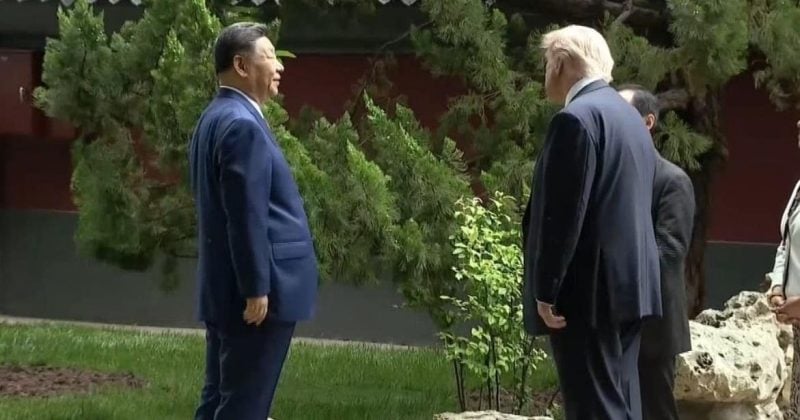
President Trump wrapped up his summit with Chinese President Xi Jinping in Beijing this week with little more than handshake optics and aspirational talking points. No deals were signed. No tariff disputes were resolved. No new frameworks emerged on any of the issues that actually move markets.
What happened in Beijing
Trump claimed that China agreed “in principle” to purchase roughly 200 Boeing aircraft, along with additional US soybeans and energy exports. That sounds significant until you notice that no contracts were disclosed, no timelines were set, and no dollar figures were attached.
On the trade front, none of the structural issues that have defined the US-China economic rivalry for years got any closer to resolution. The current tariff truce is set to expire in October, and neither side announced an extension or a path toward one.
Taiwan dominated the geopolitical conversation. Xi warned that the island remains the “most sensitive” issue in the bilateral relationship, cautioning that mishandling it could spark serious conflict. Trump, for his part, said he does not want a “fight” over Taiwanese independence and has not committed to an $11 billion arms package to Taiwan that was previously under discussion.
Trump also mentioned an agreement with Xi to prevent military equipment transfers to Iran, though Beijing offered no official confirmation of any such arrangement.
Why this matters for crypto and tech
Advanced semiconductor export controls have been one of Washington’s primary tools for containing China’s tech ambitions. Those controls restrict the flow of cutting-edge chips, the same chips that are essential for high-performance computing, AI development, and proof-of-work mining operations that rely on next-generation ASICs.
Tariffs on Chinese-manufactured electronics and components have raised costs for everything from mining rigs to networking equipment. With no extension of the current truce announced and an October expiration looming, businesses face the prospect of even higher costs if negotiations stall further.
Bitcoin miners, particularly those operating in the US or sourcing hardware from Chinese manufacturers like Bitmain, are caught in a policy limbo that makes long-term capital planning genuinely difficult.
The Taiwan factor
Taiwan isn’t just a geopolitical flashpoint. It’s the world’s semiconductor factory. TSMC, headquartered in Taiwan, fabricates the vast majority of the world’s most advanced chips. Any escalation in cross-strait tensions, even rhetorical escalation, sends ripples through every industry that depends on those chips.
Xi’s pointed warning about Taiwan and Trump’s reluctance to commit to the arms package create a strange equilibrium. Neither side wants conflict, but neither side is willing to make concessions that would reduce the risk of one.
What investors should watch
The October expiration of the tariff truce is now the most important near-term date on the US-China calendar. If it passes without an extension or a new agreement, expect renewed volatility across risk assets, including crypto.
Tech export controls are the slower-burning issue but arguably the more consequential one. Any tightening of chip restrictions would further constrain the global supply of mining hardware and AI infrastructure, both of which are increasingly intertwined with blockchain ecosystems.





Leave feedback about this