You’ve heard of AI vibe coding, one dictionary’s phrase of the year for 2025. As of this week, 2026 is shaping up to be the year of the AI vibe shift.
You wouldn’t know the shift existed from the tech world’s top pronouncements of late; it is, after all, always sunny in Silicon Valley. Microsoft’s Build conference, like Google I/O in May, featured tons of techies talking about tokens, the metric by which AI prompts and answers are measured (a token, weirdly, is about three-quarters of a word on average).
Both conferences also centered claims about frontier AI that are dubious to say the least. DeepMind CEO Demis Hassabis at Google I/O: “Artificial General Intelligence is just a few years away… we are standing in the foothills of the Singularity.” Microsoft AI CEO Mustafa Suleyman: “scaling laws are holding… we are building towards what we call Humanist Superintelligence.”
Investors, too, showed little sign of losing their AI optimism this week. Nvidia stock tumbled for a few days, but rallied after CEO Jensen Huang insisted AI agents will run everything, everywhere in the future (presumably once they’ve stopped deleting databases). Anthropic, OpenAI, and SpaceX continue to chase trillion-dollar IPOs, the latter based in large part on the untested concept of AI data centers in space.
But outside the AI bubble, a backlash is brewing, and not only among students booing pro-AI commencement speakers.
Just 10 percent of Americans say they’re thrilled about the future of AI, a Pew poll found in March; that same month, some 80 percent of registered U.S. voters in an NBC poll said neither Democrats nor Republicans are doing a good job on the AI front. That number also appears in an April survey of white-collar workers: 80 percent are straight-up refusing to use AI even when it’s mandated. In the last 30 days, 54 percent of workers reported bypassing company AI tools and completing jobs themselves.
Those numbers suggest general strike-levels of discontent with AI across every industry, out there in the real America beyond Silicon Valley and Wall Street, if not an outright revolutionary mood.
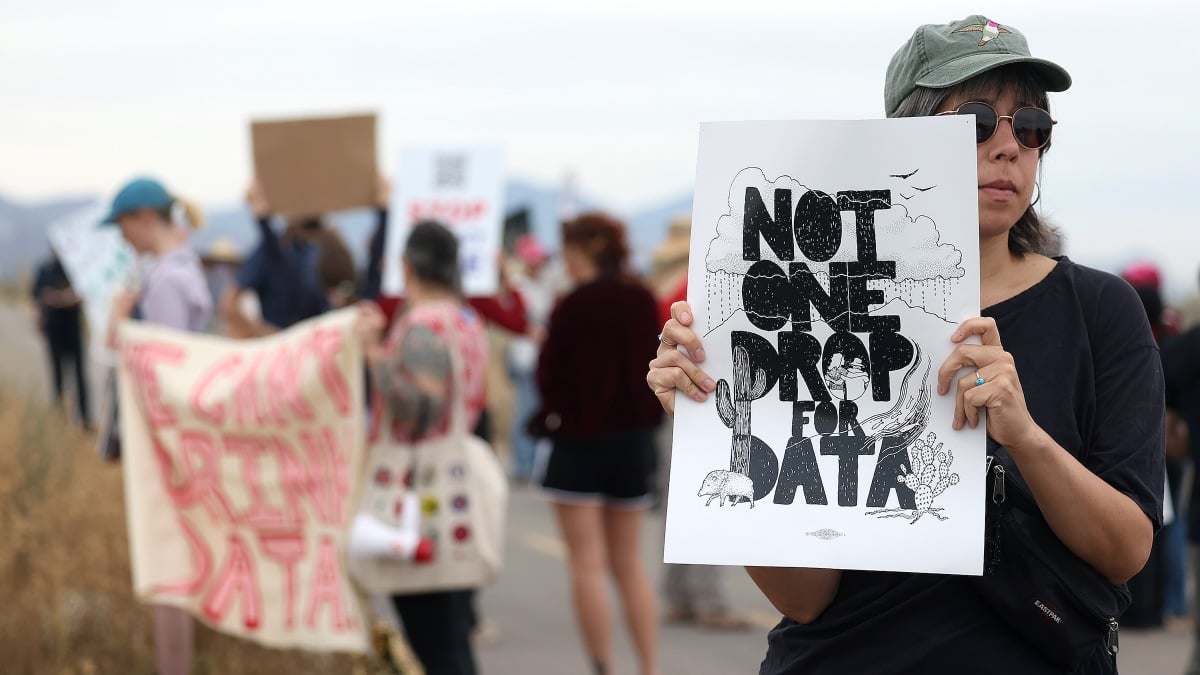
Data center protests, fueled by the 70 percent of Americans who say they don’t want data centers near them, are only likely to grow going forward — especially now that they are producing tangible results. At least 48 data center projects were blocked or delayed in 2025, according to Data Center Watch, and the fight is only getting more fierce.
Take the planned Stratos data center in Utah, where local opposition just forced VC and Shark Tank investor Kevin O’Leary to downsize his land usage by 75 percent. “We screwed up,” O’Leary told local TV news Friday. “We pissed off a lot of people.”
And the threat of electoral guillotines may explain why politicians are starting to propose serious action.
This week alone, Senator Bernie Sanders came out in favor of the U.S. public owning a 50 percent stake in AI companies, former presidential candidate Andrew Yang proposed an AI tax, and President Trump finally signed an executive order on AI regulation that his AI czar, Silicon Valley titan David Sacks, has long opposed. Finally, on Friday, New York State legislators sent a one-year data center moratorium to the governor’s desk.
The White House’s AI executive order was even announced while Microsoft CEO Satya Nadella was making rosy pronouncements on AI at Build, adding to the surreal sense that we’re watching a tale of two worlds — the anti-AI people versus an out-of-touch AI regime that says, essentially, let them eat tokens.
But hold the revolution: Just below the surface (and the Microsoft Surface Ultra), the AI regime is showing signs of cracking all on its own — and it’s all down to those tokens.
Silicon Valley’s AI backlash begins
When it comes to AI true-believer companies, they don’t get much truer than Uber. The rideshare giant says 90 percent of its engineers use AI tools, mostly Anthropic’s Claude Code. As much as 10 percent of Uber’s codebase is written by AI agents. Uber had leaderboards that encouraged as much usage of AI tokens as possible; in Silicon Valley, this is known as tokenmaxxing, and it was really hot in 2025.
Then the tokenmaxxing bill came due. “The budget I thought I would need [for 2026] is blown away already,” CTO Neppalli Naga told The Information on April 14 — less than four months into the year.
At the time, however, the information didn’t make much of a dent in the AI news cycle — not until Uber’s COO confirmed what it meant at the end of May. Naga’s busted budget was a “head-exploding moment,” Andrew MacDonald told the Rapid Response podcast. Such spending “becomes harder to justify because AI is not free…we’re going to have to start talking about token consumption.”
Just like that, we started talking about token consumption. Axios reported an unnamed company had burned through half a billion dollars of tokens in a single month “after failing to put usage limits on Claude licenses.” Next, we learned Amazon and Meta had shut down their own internal AI leaderboards; other companies like Walmart and Starbucks have scaled back their AI agent plans.
Mashable Light Speed
In a leaked email, one Amazon senior vice president told employees to “stop using AI just for the sake of using AI.” You’d be forgiven for thinking this obliterates a large chunk of OpenAI and Anthropic’s business model. Both companies have spent years building models that, for the most part, consume more tokens. Now they’re promoting agents who can consume tokens on steroids — often as much as 24 times as a regular model.
As high-minded as their missions might be, both companies are in it to sell tokens.
Why tokenmaxxing died

A scene from a data center protest in Tucson, Arizona.
Credit: Mamta Popat/Arizona Daily Star via Getty Images
Some AI leaders, sensing the shift in the wind, are starting to say that sort of thing openly. Ravi Kumar S., CEO of AI IT firm Cognizant, called tokenmaxxing “a vanity metric” at a Fortune conference on Monday. Kumar took aim at OpenAI’s Sam Altman and Anthropic’s Dario Amodei, accusing them of “fearmongering.” Altman and Amodei have walked back previous predictions of an AI jobs apocalypse now that they have IPOs in the offing.
The two CEOs are also beneficiaries of user confusion over the complex cost of AI. Earlier this year, Anthropic quietly changed the price of Claude for many customers, charging them per token. OpenAI is looking at dropping its “unlimited” ChatGPT plans — quite a change from a year ago, when Altman promised “intelligence too cheap to meter.”
The shift isn’t just happening at the two AI giants. Microsoft started cutting token costs for itself and raising token prices for everyone else — even before those rosy pronouncements at Build.
Microsoft began revoking developers’ access to Claude Code, pushing them to Microsoft Copilot instead, in May. On June 1, Github Copilot users were switched from a fixed subscription to a per-token subscription model. Reddit filled with angry users noting how expensive their AI prompts have suddenly become. In one extreme case, a Claude user blew 50 percent of his monthly credits on a single prompt.
“At the beginning of the year,” Altman said in an OpenAI livestream this week, “people were totally happy with the amount they were spending… now, all of a sudden [it’s] a huge issue.” In a CNBC interview Monday, Altman admitted to a “ton of waste” in AI spending, and said companies were asking, “how long do I have to wait for [AI benefits] to show up in revenue?” This was, Altman said, a “fair issue.”
And the closest Altman came to an answer to the fair issue? “The industry will figure that out pretty quickly… in another year or two.”
Will the vibe shift burst the AI bubble?
How long OpenAI and Anthropic have to figure out this issue, however, depends largely on what happens in their IPOs.
“Nobody knows when this will all collapse, but 2026 will be remembered in hindsight as the year in which retail investors were left holding the bag,” Gary Marcus, a professor and leading generative AI critic, predicted Monday.
Marcus, who has been increasingly proven right in the AI problems he’s foreseen since 2022, may yet be off base here. But he does have a hunch, based on comments from Anthropic cofounder Daniela Amodei, that both companies had burned so much money they were “months from bankruptcy” and had “run out of options” other than to file for trillion-dollar IPOs.
In particular, OpenAI has long been losing more than a billion dollars a month — the cost of serving ChatGPT for free to hundreds of millions of people.
This Tweet is currently unavailable. It might be loading or has been removed.
Financial bubbles built around technologies invariably end with an Emperor’s New Clothes moment. Eventually, enough people are pointing and laughing that courtiers can’t carry off the hype any longer.
That’s what happened to end the dotcom bubble in 2000. A business deal came along that was so ridiculous on its surface (the world’s largest media empire, snapped up by the guys who gave away dial-up internet via CDs?!) that markets couldn’t help but point and laugh. The vibe shifted. Overhyped, profitless dotcom companies began to look naked, and a stock collapse soon followed.
Human hiring and hallucinations
Times have changed, and the AI bubble is a hardier thing than its dotcom predecessor. It is built atop the one company currently making a fortune out of all this. NVIDIA has sold the picks and shovels to AI gold rush seekers for so many years now that they’ve started to seem invulnerable. Yet even Nvidia is learning lessons about the prohibitive growing cost of AI.
“The cost of compute is far beyond the costs of the employees,” one Nvidia executive told Axios in April. So even Nvidia is vulnerable to tokenmaxxing. And that’s why the hottest thing in AI these days is hiring humans, because they’re getting to be cheaper than AI — and are needed for quality control on AI’s output anyway. Cognizant’s Kumar boasted about his AI company hiring 20,000 graduates last year, and more this year — a vibe shift if ever we’ve seen one.
So the jobspocalypse vibe has shifted. The tokens vibe has shifted. And the AI data center-building vibe has shifted, too — not just in terms of public and environmental opposition, but in the fact that there aren’t as many data centers under construction as we’d been led to expect. (Gadfly journalist Ed Zitron has done yeoman’s work here, scouring satellite photos of data center sites for signs of construction).
What’s left? Arguably, the only vibe that hasn’t shifted is the hallucination vibe, in that users still aren’t aware how often most AI models hallucinate. Google, for example, won’t say how often Gemini 3.5 Flash hallucinates, but a December Google study found that Gemini may only be accurate 68.8 to 83.8 percent of the time.
And hallucinations aren’t hard to find these days. The hallucination that OpenAI, Anthropic, and SpaceX are genuine trillion-dollar AI giants that deserve to be listed in top index funds despite being unprofitable (breaking news: as I wrote this, the S&P 500 officially opted out of that hallucination).
The hallucination that Nvidia will always remain on top, even as companies making up a majority of its business are developing their own AI chips (which is exactly why Michael Burry, the Big Short guy, continues to short the stock).
The hallucination that customers want AI in everything, when survey after survey says the opposite. The hallucination that AI content will dominate the future, when the generation that will take us there points and laughs at AI slop.
If these hallucinations fade from the fevered brains of Silicon Valley and Wall Street, the great AI vibe shift of 2026 will be complete.
This article reflects the opinion of the author.
Disclosure: Ziff Davis, Mashable’s parent company, in April 2025 filed a lawsuit against OpenAI, alleging it infringed Ziff Davis copyrights in training and operating its AI systems.



Leave feedback about this