

Moon Pursuit Capital has urged professional crypto investors to use systematic strategies instead of relying on Federal Reserve forecasts after Bitcoin gained 22.1% in seven days and approached $80,000.
Summary
- Bitcoin gained 22.1% during its strongest week since March 2024.
- Kevin Warsh will deliver his first Jackson Hole keynote as Fed chair on Aug. 28.
- Moon Pursuit Capital says limited liquidity can amplify capital flows in either direction.
- Market-neutral strategies reduce directional exposure but can miss much of Bitcoin’s upside.
Moon Pursuit Capital Principal Courtney Olujobi told crypto.news that Jackson Hole remains important for digital assets because expectations for U.S. monetary policy continue to affect liquidity and investors’ willingness to take risks.
“Jackson Hole matters for digital assets because Fed expectations continue to influence liquidity and risk appetite across markets,” Olujobi said.
A more accommodative signal from the Fed could support Bitcoin and other risk assets, while a restrictive message could quickly revive volatility, he added. Rather than trying to predict which message Warsh will deliver, Olujobi said institutions should construct portfolios capable of operating under different economic conditions.
Bitcoin liquidity can amplify a change in Fed expectations
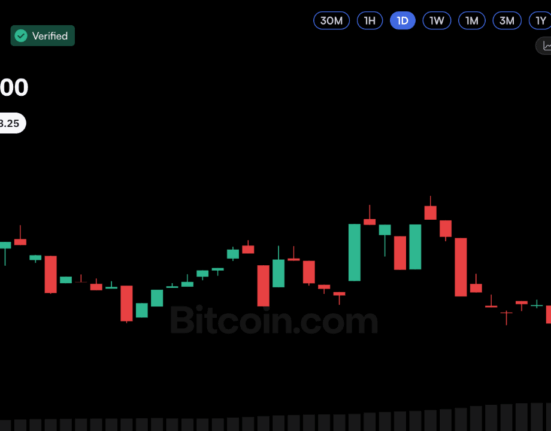
Bitcoin entered the week near $77,364 after gaining 22.1% across seven days, according to market data cited in a previous crypto.news report on the next Bitcoin catalysts. The asset had climbed from approximately $64,000 and briefly tested $80,000 during its strongest weekly advance since March 2024.
Federal Reserve Chair Kevin Warsh is scheduled to deliver his first Jackson Hole keynote at 10 a.m. ET on Aug. 28. The Federal Reserve Bank of Kansas City will hold the symposium from Aug. 27 to Aug. 29 under the theme “Financial Innovation: Implications for Payments and Policy.”
Olujobi said crypto prices do not respond only to the size of a policy decision. The amount of available liquidity and the limited supply of assets offered for sale can determine how strongly prices react when new capital enters or leaves the market.
“What we would emphasize is that digital assets do not respond to the size of a policy move so much as to how much liquidity is standing in the way.”
Stablecoin supply stands at about $308 billion, up approximately 14% from a year earlier but below its May peak, according to figures cited by Olujobi. He described part of the supply as capital that investors could deploy through exchanges, although the total stablecoin market also includes tokens used for payments, savings, lending and decentralized finance.
At the same time, Olujobi estimated that only about 13% of circulating Bitcoin is actively available for trading in public markets. The figure should be treated as Moon Pursuit Capital’s estimate because publicly reported exchange balances do not capture every source of tradable Bitcoin, including spot exchange-traded funds, institutional custodians and over-the-counter desks.
With less Bitcoin available for immediate sale, Olujobi said incoming capital can move prices quickly. The same structure can accelerate losses when investors reduce positions or leveraged trades begin closing.
“That combination means capital flows are transmitted into price very quickly, in both directions,” he said.
Treasury buybacks showed how quickly Bitcoin could move
A U.S. Treasury announcement on Aug. 19 provided a recent example of the transmission process described by Olujobi. The department said it would increase the maximum size of its liquidity-support buybacks for long-dated government securities from $2 billion to at least $4 billion per operation.
Covering the 10-to-20-year and 20-to-30-year maturity sectors, the expanded operations will begin Sept. 9 and remain in effect through Nov. 4. The Treasury plans to provide an update at its next quarterly refunding.
The program is a debt-management operation rather than quantitative easing or a Federal Reserve policy decision. No purchases under the increased limit had taken place when Bitcoin began rising because the new size would not take effect until September.
Markets instead reacted to the announcement and its possible effect on long-term Treasury liquidity. During the first part of the move, Bitcoin climbed from an intraday low near $64,100 to approximately $69,500 in less than 12 hours.
As previously covered in the Treasury buyback analysis, short liquidations reached about $1.44 billion across major exchanges within 24 hours. Roughly $1.29 billion of bearish positions closed during one hour, while more than 110,000 traders were liquidated.
Forced liquidations can add buying pressure because exchanges must close bearish positions as prices rise. Bitcoin continued climbing over the following sessions, eventually crossing $80,000 on Aug. 25 and reaching an intraday high above $81,000.
Olujobi said the crypto market added approximately $280 billion during one 24-hour period as the rally developed. Bitcoin’s full advance from below $65,000 to nearly $80,000, however, occurred across several days rather than within the same 24-hour window.
“The same market structure works in reverse, and historically it works faster,” he said.
Systematic strategies reduce reliance on Bitcoin direction
For professional investors, Olujobi said the main issue is not whether they can accurately forecast the Fed’s next decision. Portfolio construction determines how investors perform when economic conditions, liquidity, or volatility change.
“From an institutional investor’s perspective, the bigger question isn’t whether you can correctly predict the Fed’s next move. It’s whether your portfolio is constructed to perform when the macro environment changes.”
Market-neutral strategies seek to limit exposure to the direction of the overall market. Depending on their design, managers may hold a long position in one asset while taking an offsetting short position in another, trade differences between spot and futures prices, or use quantitative signals to identify relative pricing opportunities.
Systematic strategies follow predefined rules for selecting trades, setting position sizes, and controlling risk. Olujobi said such methods can give institutional investors access to opportunities created by volatility and market structure without requiring Bitcoin to keep rising.
Rather than depending entirely on a bullish Bitcoin position, investors can trade relative prices while maintaining set position sizes and risk limits, he added. Market-neutral funds still face trading, model, counterparty, liquidity, and execution risks, and their hedges can limit returns during a strong market advance.
“The tradeoff is worth stating plainly: a market neutral book gives up much of the upside in a week like the one we just had,” Olujobi said.
CoinShares offers one example of the approach within institutional crypto markets. The asset manager describes its market-neutral strategy as seeking positive returns independent of market direction through quantitative signals applied across a portfolio of major cryptocurrencies.
U.S. ETF flows have provided direct spot demand
For American investors, U.S.-listed spot Bitcoin ETFs have added a regulated source of exposure and a visible measure of institutional demand. The funds received approximately $1.9 billion during the week ending Aug. 21, their strongest weekly intake since October 2025.
Five consecutive sessions ended with net inflows, including about $606 million on Aug. 20. BlackRock’s iShares Bitcoin Trust accounted for a large share of the purchases, while ETF demand helped absorb available supply as Bitcoin cleared several resistance levels.
Analysts previously said continued spot demand would become more important once forced short covering slowed. During the first stage of the breakout, Bitcoin rose between 10% and 11% while aggregate open interest increased by about 4%, according to Bitfinex analysts cited in the report.
The limited increase in open interest indicated that the rally included spot purchases and short covering rather than being driven mainly by new leveraged long positions, the analysts said. Lacie Zhang, a research analyst at Bitget Wallet, also attributed support to ETF purchases, macro conditions and progress on U.S. crypto policy, while warning that the speed of the advance required continued cash-market buying.
Warsh’s Jackson Hole address will arrive after the Fed voted 9–3 in July to keep its target rate at 3.50% to 3.75%. Three officials preferred a quarter-point increase, while Warsh declined to commit to a fixed policy path during his post-meeting remarks.
U.S. investors will also receive the July personal consumption expenditures inflation report and revised second-quarter gross domestic product data before the speech. The Fed’s preferred core PCE measure stood at 3.3% in June, above its 2% objective, while the initial estimate placed second-quarter economic growth at 1.5%.






Leave feedback about this