

Solana has drawn fresh attention from Fidelity Digital Assets after the investment firm’s latest research found that the blockchain accounted for roughly 15% of the trades measured against major U.S. exchanges in 2026, briefly surpassing the New York Stock Exchange in weekly executions.
Summary
- Fidelity found Solana represented approximately 15% of compared exchange trades during 2026, measured by count.
- Solana briefly exceeded New York Stock Exchange executions, although the two markets trade different instruments.
- Solana said monthly tokenized asset trading reached nearly $5 billion, compared with under $100 million.
- Fidelity reported more than $590 billion in Solana perpetual futures notional volume over twelve months.
- SOL traded near $89.59 on November 8, while Fidelity warned network revenue depends on trading.
Fidelity Digital Assets, in its November 6 report, examined Solana’s trading activity, transaction costs, network performance and growing market for tokenized financial assets. Senior digital assets research analyst Max Wadington described the blockchain as an increasingly competitive trading venue, although its activity still differs from that of traditional stock exchanges.
Solana promoted the findings on November 8, saying its share of the compared exchange activity had risen from 0.30% in 2022. The network’s announcement pointed to growing tokenized-asset trading and Fidelity’s assessment of Solana as a potential part of financial market infrastructure.
Fidelity Compares Solana Trading Activity With U.S. Exchanges
The report found that Solana averaged approximately 15% of the exchange trades included in Fidelity’s comparison during 2026. At one point, its weekly trade count exceeded that of the New York Stock Exchange.
The measurement concerns the number of trades executed, not the dollar value of assets exchanged. Fidelity’s comparison uses decentralized spot exchange trades on Solana alongside activity from traditional venues, where transactions involve different instruments, trading rules and market participants.
Much of Solana’s activity involves cryptocurrencies and other digital assets. U.S. stock exchanges, meanwhile, handle regulated securities, with substantial trading taking place through alternative trading systems and other off-exchange venues.
Fidelity cited Nasdaq research indicating that approximately 50% of U.S. equity trading volume occurred away from exchanges in 2025. Consequently, the figures do not establish that Solana handles 15% of the entire American securities market.
The investment firm nevertheless argued that the network’s ability to process large numbers of trades deserves consideration alongside established financial marketplaces.
“An emerging piece of financial market infrastructure,” Fidelity wrote, describing Solana’s growing role while acknowledging that scale alone does not guarantee long-term success.
Solana Network Upgrades Support Faster Trading
Alongside trading activity, Fidelity examined improvements intended to make transaction processing faster and more predictable for professional traders.
Its research noted that Solana’s slot times had stabilized near 400 milliseconds, with developers working toward a longer-term target of approximately 200 milliseconds. More predictable block production allows trading applications to plan around shorter processing intervals.
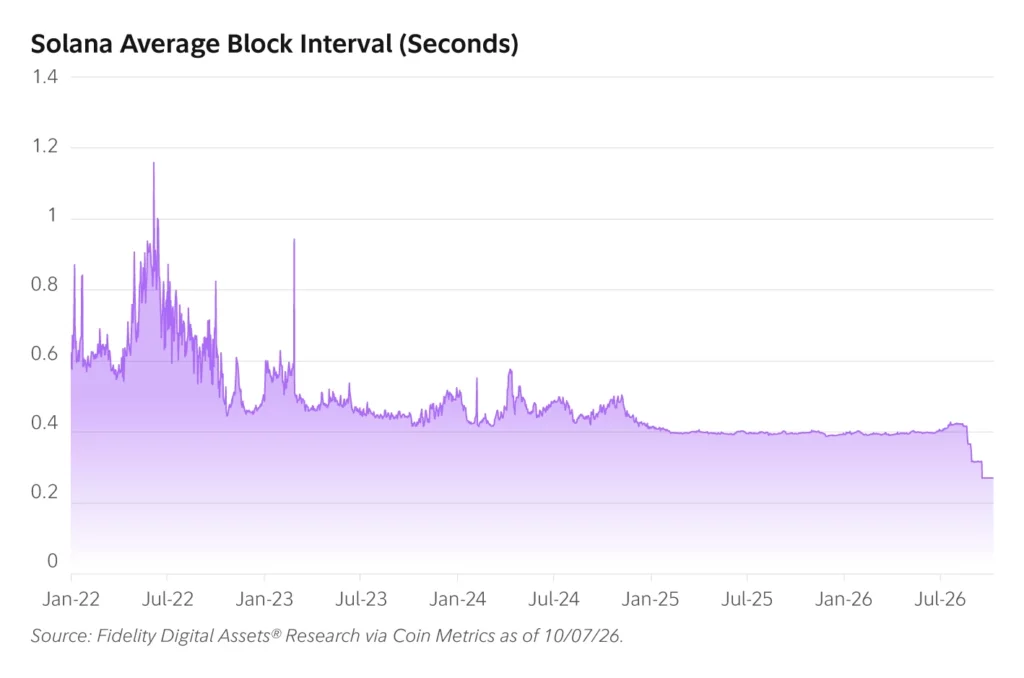
The network recently raised its maximum block capacity from 60 million to 100 million compute units, a 66% increase. Compute units measure the processing resources consumed by transactions, so the higher limit allows more activity within individual blocks.
Another development involves Alpenglow, Solana’s upgraded consensus system. As crypto.news reported after mainnet activation, the upgrade went live on October 21 and targets transaction finality near 150 milliseconds.
An independent October 23 measurement recorded median finality around 404 milliseconds, indicating that observed performance remained above the network’s target.
Fidelity identified transaction inclusion, reliable execution and low fees as important considerations for market makers. Its analysis noted that proprietary automated market makers increasingly compete to provide prices and liquidity without relying entirely on conventional decentralized liquidity pools.
Tokenized Assets and Perpetual Futures Expand Trading
The report examined how Solana’s available financial products have expanded beyond ordinary cryptocurrency spot trading.
In its November 8 announcement, Solana said monthly tokenized-asset trading volume had grown from less than $100 million to nearly $5 billion. Fidelity’s research charts the growth of tokenized assets, including equities, Treasury products, commodities and private credit instruments.
Such products remain subject to different ownership arrangements, investor eligibility requirements and transfer restrictions.
In October, Securitize confirmed 12 tokenized stocks were available on Solana for eligible investors, including products referencing Apple, Nvidia and Tesla.
Fidelity examined derivatives activity as another source of trading demand. Solana-based perpetual futures platforms processed more than $590 billion in notional trading volume during the preceding 12 months, according to the report.
Perpetual futures allow traders to take leveraged positions without owning the underlying asset, creating another market where participants compete for execution.
Solana Price Falls as Fidelity Examines Network Revenue
Fidelity’s assessment arrived while SOL continued trading under pressure.
According to crypto.news market data, Solana traded near $89.59 on November 8, down 0.36% over 24 hours and 19.24% during the previous month. Its market capitalization stood around $52.95 billion, with daily trading volume near $870.4 million.
Recent Solana ETF withdrawals provided another measure of investor activity. U.S. spot funds recorded approximately $24.82 million in combined net outflows on October 27 and 28.
Fidelity explained that Solana earns transaction-related revenue through base fees, priority fees, validator voting costs and payments for transaction ordering, including Jito tips.
The report identified trading competition as an important revenue source because market makers and arbitrage traders may pay extra to secure profitable transactions.
Fidelity warned that revenue remains exposed to changing trading conditions. During weaker cryptocurrency markets, fewer profitable trading opportunities can reduce demand for priority execution and related fees.





Leave feedback about this