
US inflation reportedly cooled, and the Fed already cut rates three times, but Bitcoin price keeps stalling every time it pokes near $90,000, just like it did yesterday, the 22nd of December.
Watching the order books on Binance and Coinbase during Monday’s European session, it was clear that $90,000 wasn’t just a psychological wall or a large sell wall; it was being refreshed every time the price ticked up, suggesting sophisticated ‘limit’ selling rather than a retail panic.
On the surface, this looks like a bullish macro backdrop, but under the hood, the inflation data looks messy, and Bitcoin’s own liquidity looks tired.
What Does This “Perfect” Inflation Report Really Mean for Bitcoin?
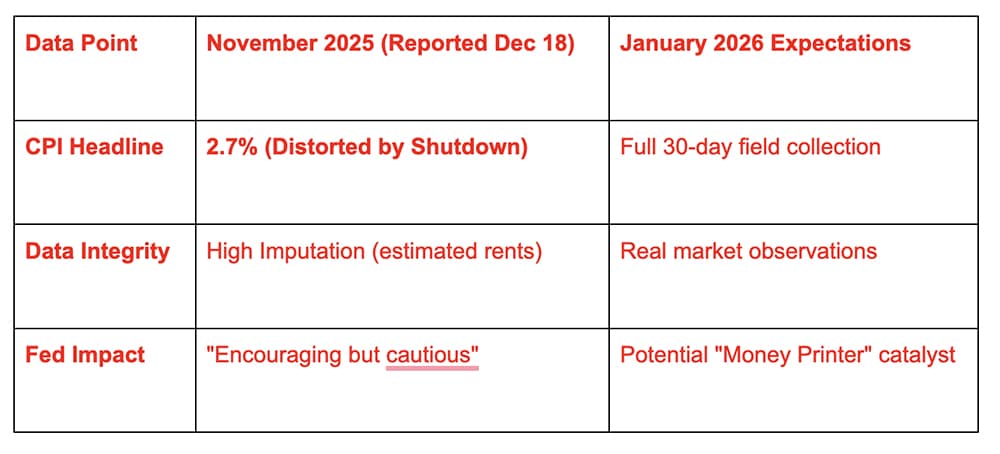
Let’s start with the big headline: November US CPI showed 2.7% year-over-year inflation, lower than the 3.1% that economists expected, and core inflation dropped to 2.6%. That sounds like exactly what risk assets, including Bitcoin, usually love. Lower inflation normally means cheaper money and easier conditions for assets that people buy for growth or as an inflation hedge.
GDP data just came in at 4.3% which is a huge increase from the forecasted 3.3%.
Same goes for CPI data last week which had a big deviation at 2.7% against the 3.1% forecast.
You don't often see differences this big, can we trust this data?
Very suspicious indeed. #CPI #GDP pic.twitter.com/pV4RyXXCUV
— JNFateful (@jn_fateful) December 23, 2025
But this report comes with an asterisk. Because of a six-week government shutdown, the US never published October CPI and statisticians had to estimate chunks of November data instead of using real price observations.
Rents and some services, which carry heavy weight in CPI, relied on modeled numbers, not actual market readings. When the data that moves trillions of dollars comes from estimates, big money steps back and waits.
The Fed noticed this problem. Governor John Williams called the inflation print “encouraging,” but he also warned that shutdown distortions affect both inflation and unemployment. This means that the Fed likes the direction, but it does not trust this single report enough to open the floodgates. Williams then said there is “no immediate need” for more cuts and described policy as “well balanced”, that is Fed-speak for “don’t expect a money printer party yet.”
For Bitcoin investors, this matters because BTC has started to trade like a macro asset. In 2025, traders watched CPI days the same way stock traders watched earnings season. When the market thinks the Fed will keep real interest rates high for longer because the data looks noisy, it stays cautious on Bitcoin, too.
Below is a comparison table on why this matters, comparing Noisy November vs the upcoming “clean” January.
DISCOVER: 16+ New and Upcoming Binance Listings in 2025
Why Isn’t Good Macro News Pushing Bitcoin Price Higher?
Even with three rate cuts, real yields – that is, interest rates after inflation – still sit around 1.9% on 10‑year TIPS. Back in 2020–21, these real rates were negative, which made holding cash painful and pushed investors into Bitcoin and other risk assets. Today, you actually earn something on safe government bonds, so the pressure to chase Bitcoin at any price is much lower.
The Fed also stopped quantitative tightening on Dec. 1, which sounds bullish at first glance. But the central bank stressed that its new asset purchases are “technical,” not a new wave of full-blown quantitative easing. Think of it like a mechanic keeping the engine from stalling, not slamming the accelerator. That means no big liquidity tsunami yet, which explains why BTC is not blasting through $90,000 as it did at previous milestones.
THE REAL REASON CRYPTO IS CLIMBING….
It is not because of charts, or indicators…
It is because the Quantitative tightening headwind that crypto has been struggling against since early 2022 has been removed…
More rate cuts, more money printing more risk on..
This is… pic.twitter.com/0DeBl9F6fa
— The House Of Crypto (@Peter_thoc) December 3, 2025
On top of that, the Bank of Japan raised rates to 0.75%, the highest in decades. Many global funds used to borrow in cheap yen and invest in risk assets worldwide – the so‑called carry trade. When Japan slowly removes that zero-rate anchor, those investors know that a sharp yen move could force them to unwind trades and sell assets, including Bitcoin. Even if that squeeze has not hit yet, the threat alone makes traders wary of taking on big new BTC exposure at the top of the range.
Now zoom in on Bitcoin itself. On‑chain data firms report that BTC market depth – the amount of buy and sell orders sitting near the current price – dropped around 30% from its 2025 peak. That means thinner order books. Imagine trying to sell a big stack of coins in a small local market instead of a giant stock exchange; your trade moves the price more. ETF data tells a similar story: Bitcoin ETFs saw billions in outflows in November, which drained some of the easy demand that powered the October run to $126,000.
There is also a large band of “underwater” supply between roughly $93,000 and $120,000, where many buyers sit on losses. Every time BTC pops toward $90K and above, some of those holders are eager to sell and escape break‑even. That creates a ceiling. If you want more detail on how these levels shape price, our recent coverage of Bitcoin’s rejection at $90K walks through the price action.
What Should Everyday Bitcoin Investors Do With This Stalemate?
First, treat this as a reminder that macro data can be messy and late, while your money is real and instant. Inflation reports that rely on estimated rents can swing Fed expectations, which in turn swing Bitcoin, even if the underlying economy has not changed much. Large funds know this, so they often wait for a “clean” follow‑up print before making big bets. You can borrow that patience.
If you already hold Bitcoin, this kind of sideways chop near a big round number is normal. BTC stalled around $70K and $80K earlier in 2025 when macro narratives looked uncertain, then eventually moved once new data and liquidity arrived. What matters more than guessing the next $5,000 move is whether you sized your position for your risk tolerance and time horizon. If a 20–30% drop would ruin your finances, you hold too much Bitcoin.
If you are thinking about buying, do not treat “inflation is falling” as an all‑clear signal. The Fed still runs positive real rates, Japan is only slowly normalizing, and Bitcoin liquidity has thinned. That combination means sharp moves in both directions remain on the table. Dollar‑cost averaging – buying small, regular amounts instead of one big lump sum – can reduce the stress of trying to time a breakout above $90K. Our recent market update around Bitcoin holding $89K shows how this slow‑and‑steady approach fits choppy conditions.
GM GM!
playing crypto in 2026
– Get positioned early, not emotionally
– Consistency > intensity
– Risk management is alpha
– Greed kills good portfolios
– Think in cycles, not candles
– Profits arent real until they are bookedNext cycle won’t be easy but it’ll be worth it.
— Keval Gala (@kevalgala03) December 22, 2025
Above all, remember that Bitcoin remains a high‑risk asset, even if it behaves more like a macro barometer now. Never use rent money or emergency savings to chase a breakout, no matter how good the inflation headline looks. The next clean CPI report in early 2026, and any shift from neutral Fed policy toward real easing, will likely decide whether Bitcoin finally clears $90,000 with conviction or spends more time grinding in this range.
EXPLORE: Best Meme Coin ICOs to Invest in 2025
Follow 99Bitcoins on X For the Latest Market Updates and Subscribe on YouTube For Daily Expert Market Analysis.
The post Why Bitcoin Price Can’t Clear $90K Even With “Perfect” Inflation appeared first on 99Bitcoins.






Leave feedback about this