Binance bStocks has overtaken xStocks to become the second-largest tokenized stock issuer by value, less than two months after the product entered the market.
Summary
- Binance bStocks has become the second largest tokenized stock issuer, reaching $610.6 million in value.
- BStocks moved ahead of xStocks less than two months after its June launch.
- Ondo Finance remains the largest issuer, while the tokenized stock market tracked by Token Terminal has grown to about $2.7 billion.
- Binance co founder Changpeng Zhao attributed bStocks’ rapid growth to the exchange’s existing user base.
Token Terminal data showed bStocks reached about $624 million in value on Aug. 3, moving ahead of xStocks at roughly $579 million while remaining behind Ondo Finance, which held about $927 million.
As of Tuesday, the gap between the two closest competitors had narrowed. BStocks held $610.6 million, compared with $601.2 million for xStocks, while Ondo remained the largest issuer in the Token Terminal ranking.
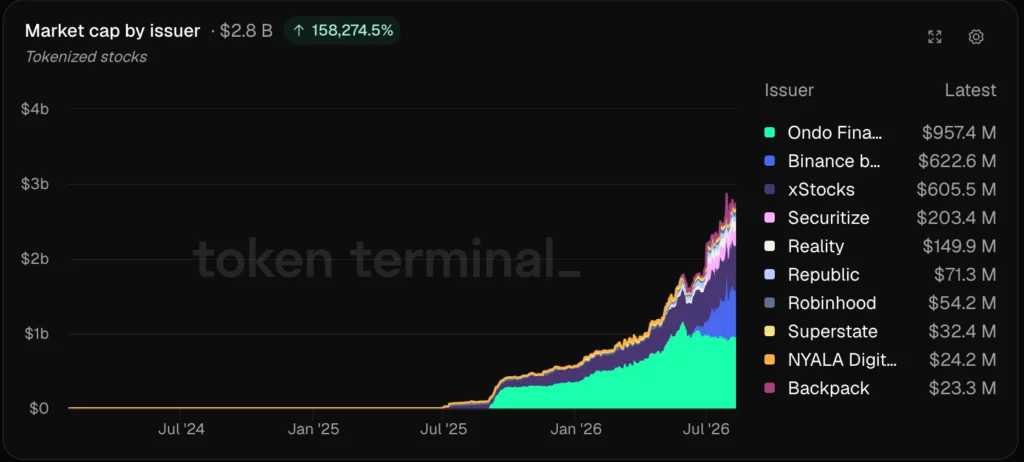
Tokenized stocks market cap by issuer. Source: Token Terminal data.
The change has come during a sharp expansion in tokenized equities, with the total value tracked by Token Terminal climbing from roughly $80 million a year ago to about $2.7 billion.
Binance bStocks has climbed to second place within two months
Launched in June, bStocks has gained more than $600 million in value in a matter of weeks, putting Binance ahead of an issuer that had been one of the largest names in tokenized equities before the exchange entered the market.
Binance introduced the product as part of its push to combine access to traditional equities with blockchain settlement. The tokens give eligible investors exposure to U.S. stocks through onchain assets rather than requiring them to directly hold the underlying shares.
The exchange’s entry had already gathered significant activity during its first weeks. As crypto.news reported in June, Binance’s equities business averaged about $143 million in daily trading volume during its first nine trading days, according to CoinDesk Research. Turnover exceeded $1 billion during the period, while daily active traders peaked at 30,700 and total value locked approached $400 million.
Those early figures preceded the rise in bStocks’ issuer value above $600 million recorded by Token Terminal in August.
Binance co-founder and former CEO Changpeng Zhao attributed the rapid expansion of bStocks to the exchange’s existing user base, giving the new product access to a large pool of crypto traders from launch.
Tokenized stock rankings have changed sharply in a year
Token Terminal’s historical figures show how quickly the issuer rankings have changed alongside the growth of the market.
A year ago, xStocks held about $40.7 million and ranked ahead of Robinhood at $37.2 million. Ondo Finance, now the largest issuer in the dataset, had only about $65,000 at the time.
The combined market tracked by Token Terminal was worth roughly $80 million during the same period. By August 2026, the figure had risen to around $2.7 billion, an increase of more than 30 times within a year.
Competition was already building before Binance launched bStocks. In May, Bitget Wallet integrated xStocks, giving its users access to more than 130 tokenized stocks and exchange-traded funds through a self-custodial wallet. At the time, RWA.xyz data placed Ondo and xStocks among the leading tokenized equity platforms by asset value.
Kraken-backed xStocks had also expanded its onchain infrastructure earlier in the year. Its xChange trading engine, introduced in March, supported more than 70 tokenized equities across Ethereum and Solana and had recorded $3.5 billion in onchain volume, $25 billion in total trading volume and 80,000 holders at the time.
By August, however, Binance’s bStocks had moved narrowly ahead of xStocks by issuer value while Ondo occupied the top position.
Binance built bStocks around tokenized U.S. equities
Binance’s latest position follows a rapid rollout of stock products that began in June.
The exchange launched its first bStocks with tokenized versions of U.S. equities including Nvidia, Tesla, Circle, Micron and Sandisk. The structure allows eligible users to hold blockchain-based representations of securities and trade them outside the standard market-hours model.
Issued by Binance affiliate BTech Holdings Limited, the products are backed 1:1 by corresponding underlying securities. Holders receive economic exposure to the linked assets but do not receive the voting rights and other shareholder privileges associated with direct stock ownership.
Binance also allows eligible users to convert supported stock positions into bStocks and convert them back at a 1:1 ratio without conversion fees.
Alongside tokenization, Binance has been building direct access to traditional equities for users outside the United States. In June, the exchange outlined plans for access to more than 7,000 U.S. stocks and ETFs, including fractional purchases starting at $5 and funding through USDT, USDC, BNB and selected cryptocurrencies.
The two products use different structures. Direct stock trading provides eligible users with conventional equity exposure through the exchange, while bStocks move supported positions into blockchain-based tokens that can be transferred and used onchain.
Ondo and Robinhood are expanding their own stock products
Ondo’s lead in the Token Terminal rankings comes after the company expanded the regulatory and distribution footprint of its tokenized securities.
Earlier this year, Binance Alpha added Ondo Global Markets products covering major U.S. stocks and ETFs. The initial lineup included tokenized versions of Apple, Tesla, Nvidia, Amazon, Meta, Microsoft and Alphabet, as well as the Invesco QQQ ETF. The securities were offered under a regulated structure in Abu Dhabi Global Market and were unavailable to U.S. users.
Ondo later completed a live onchain deployment of tokenized U.S. securities under a structure designed to work within existing U.S. rules. The July rollout placed BlackRock’s iShares Core S&P 500 ETF and Micron Technology shares on Ethereum while keeping the underlying securities within regulated U.S. custody infrastructure.
Robinhood has also expanded its tokenized equity business after ranking close to xStocks a year ago. The company launched its Layer 2 mainnet in July with tokenized stock trading and decentralized finance features, allowing eligible users in more than 120 countries to trade supported stock tokens through Robinhood Wallet on decentralized exchanges.
The expansion has taken place as tokenized stocks have become one of the fastest-growing parts of the real-world asset market. Binance Research reported in June that tokenized stocks had increased 422% during the measured period, while the overall market for active tokenized real-world assets had risen 589% since early 2025.
In a separate June report, Binance Research estimated that crypto exchanges could route as much as $2 trillion in new capital and nearly 300 million additional investors into global equity markets by 2031. The report said 93% of Binance’s stock-trading users came from emerging markets and noted that adoption would depend on factors including regulation, custody, liquidity, user eligibility and exchange support.





Leave feedback about this