
Key Takeaways
- Bitcoin fell 1% to $59,300 Wednesday as Trump tariff fears erased Jensen Huang’s Nvidia rally.
- The downturn triggered $579 million in crypto liquidations as Strategy shifted to balance sheet defense.
- Bitfinex warns spot demand must return within two weeks before leveraged long positions unwind further.
Bitcoin Slides Below $58,000 as Tariff War Fears Resurface
Bitcoin fell for a second consecutive day Wednesday, with a sharp midmorning drop driven by reports that the Trump administration plans to reignite a tariff war with major U.S. trading partners. The sell-off effectively dashed lingering hopes that Jensen Huang’s reinstatement as Nvidia CEO would fuel a broader cryptocurrency market recovery.
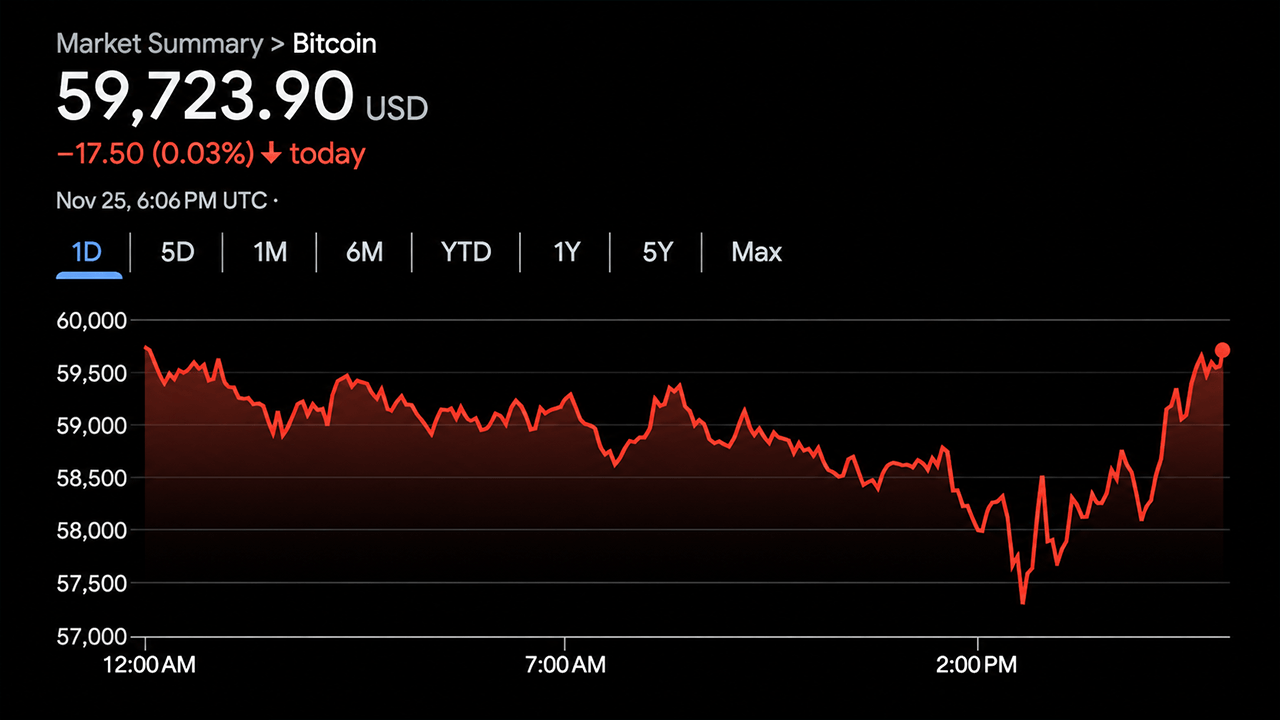
Market data show that after plunging to an intraday low of $57,209 at 10:45 a.m. EST, bitcoin staged a brief rebound, reclaiming $58,000 and nearly touching $59,000 shortly after midday. However, a swift pullback dragged the price toward $58,000, extending a broader downtrend that had already seen the cryptocurrency slide from $60,000 to $58,500.
By 1:15 p.m. EST, bitcoin hovered just below $59,723, marking a nearly 1% decline over 24 hours. At that level, the cryptocurrency was down 7.41% from Monday’s peak of $64,505 and nearly 25% since the start of the month. Approximately $95.5 billion has been wiped from bitcoin’s market capitalization since Huang’s reinstatement briefly pushed its price above $64,000.
Crypto Liquidations Surge to $579 Million
The downturn triggered heavy derivatives liquidations, with bitcoin liquidations exceeding $213 million, nearly $138 million of which came from long positions. Across the broader cryptocurrency market, total liquidations reached $579 million, comprising $407 million in long positions and $172 million in short positions.
Looking ahead, Bitfinex analysts emphasized that the decisive factor over the next two weeks will not be whether U.S. technology stocks continue to rally but whether unleveraged spot demand returns before crowded long positions are forced to unwind.
“If spot buyers remain sidelined, options positioning suggests dealer hedging could accelerate downside momentum into the $58,000 to $64,000 range,” the analysts warned. Bitcoin was already trading near the lower end of that range Wednesday.
Persistent U.S. inflation also continues to weigh on risk assets. According to Salman Parcy of Cequire Capital, October’s personal consumption expenditures (PCE) report shows inflation is cooling more slowly than expected. Both headline and core inflation rose 0.3% from the previous month, while annual core PCE inflation reached 3.3%, exceeding the 3.2% forecast.
“This is rather bad news for crypto markets, as it creates a difficult monetary policy backdrop,” Parcy said. “The Federal Reserve has less room to ease rates, and the prospect of further tightening could keep liquidity conditions restrictive, which negatively impacts Bitcoin and other risk assets.”
Although the inflation reading was not overwhelmingly bearish on its own, Parcy noted that it complicates prospects for a near-term recovery, which will likely depend on improving macroeconomic conditions and a broader return of institutional capital.
Bitcoin’s Growing Reliance on Leverage
Bitfinex Alpha analysts also attributed bitcoin’s underperformance to a structural shift toward leveraged trading as spot investors retreat, leaving prices vulnerable to a sharp unwinding of leveraged positions.
The analysts noted that since the tech-heavy Nasdaq-100 reached its all-time high Oct. 6, bitcoin has lagged during equity rallies while suffering steeper losses during downturns. Over the past 35 trading days, bitcoin gained an average of just 0.49% on days the index rose, compared with the index’s average gain of 1.67%. On days the index fell, bitcoin lost an average of 1.87%, compared with the index’s 1.73% decline.
“Our reading is that holders of BTC are using strength in equity markets to exit positions at a loss or near breakeven,” Bitfinex analysts wrote.
While buyers remain active at current price levels, demand has shifted from unleveraged spot accumulation toward leveraged positioning. With investors withdrawing nearly $5 billion from spot exchange-traded funds over the past month and short-term holders selling into stock market rallies, a market supported primarily by rising open interest and positive funding rates is becoming increasingly fragile.
Corporate Buyers Shift to Balance Sheet Defense
Institutional and corporate demand is also showing signs of strain amid deteriorating market sentiment. The centralized crypto exchange MEXC’s CEO, Vugar Usi Zade, said corporate demand is closely tied to market conditions, pointing to two significant shifts in the corporate bitcoin treasury landscape since the summer.
In June, Strategy launched its BTC Monetization Program, allowing bitcoin sales to fund reserves, dividend payments and share buybacks. Although Strategy has never engaged in forced selling and maintains $4.8 billion in U.S. dollar assets that it continues to replenish, Usi Zade said investors can no longer assume with the same confidence they had in 2024 that the company will never sell its bitcoin holdings.
The shift highlights how even bitcoin’s largest corporate buyer is prioritizing balance sheet management over continued accumulation. Meanwhile, corporate treasury activity has become increasingly uneven. Japan’s Metaplanet was among the few companies repurchasing shares, buying back roughly 7% of its outstanding stock, while U.K.-based Satsuma Technology was liquidated by its owners.
“In case there is a financial downturn, the biggest buyer moves from receiving coins to protecting the structure that funds them,” Usi Zade said.
He added that companies treating financing costs and their own stock performance as primary risks will be better positioned to resume bitcoin purchases when market conditions improve than those treating such considerations as secondary.








Leave feedback about this