
Licensed cryptocurrency exchange Coins.ph began prohibiting direct on-chain deposits and withdrawals involving self-custody wallets on Nov. 19, 2026, restricting external digital asset transfers exclusively to accounts at other regulated exchanges.
- When asked about what constitutes a regulated exchange, Coins.ph CEO Wei Zhou told BitPinas that both “local and international” platforms qualify. This means transfers are not restricted solely to Bangko Sentral ng Pilipinas (BSP)-licensed exchanges, provided the foreign platform is regulated in its jurisdiction.
Under the updated policy, the platform requires sender and recipient Travel Rule information for every on-chain cryptocurrency deposit and withdrawal regardless of transaction value. Coins.ph stated in a user advisory that the changes comply with regulations issued by the BSP.
New Deposit and Withdrawal Procedures
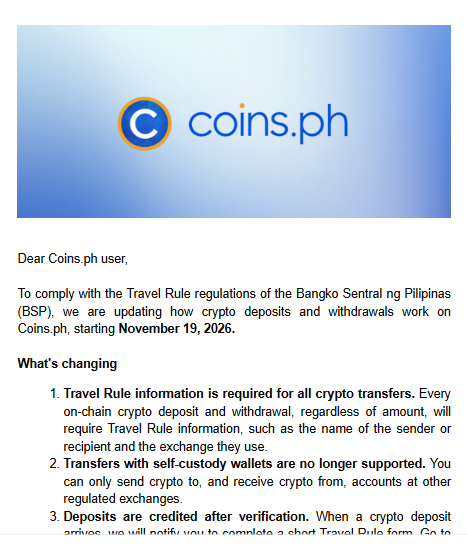
According to the email sent to customers:
- Users initiating cryptocurrency withdrawals must provide the recipient’s full name and verify that the destination wallet address belongs to an account at a regulated exchange.
- Any attempted withdrawal to a self-custody wallet will automatically fail, leaving the funds in the sender’s Coins.ph account.
- For incoming transfers, Coins.ph now holds all cryptocurrency deposits in pending status until the account holder completes a Travel Rule verification form through the platform’s dashboard or pending transactions menu.
- Deposits identified as originating from self-custody wallets will be rejected and returned to the sending address minus applicable blockchain network fees, with select transactions subject to manual review prior to return.
“These changes are required by regulation and help keep crypto transfers safe and transparent,” Coins.ph said in its customer notice.
FATF Standards and BSP Travel Rule Compliance
The operational overhaul aligns with anti-money laundering and counter-terrorism financing standards established by the Financial Action Task Force (FATF), the global financial crime watchdog. Under the FATF Travel Rule, virtual asset service providers (VASPs) must collect, verify and transmit originator and beneficiary data alongside digital asset transfers.
In the Philippines, the central bank enforced the Travel Rule through BSP Circular No. 1108 in 2021, which initially mandated originator and beneficiary disclosures for virtual asset transfers of ₱50,000 or more. In 2023, BSP Memorandum No. M-2023-042 further clarified that VASPs must screen transacting parties against sanctions lists and conduct customer due diligence on transfers involving unhosted wallets, prohibiting institutions from facilitating transfers when minimum counterparty information is incomplete.
Philippine financial regulators have maintained strict supervisory scrutiny over licensed VASPs and electronic money issuers following the country’s removal from the FATF grey list on Feb. 21, 2025, as authorities prepare for the next FATF mutual evaluation scheduled for 2027.
DCPay Partial Suspension
The updated cryptocurrency transfer rules follow separate central bank enforcement involving Coins.ph’s fiat payment operations. While consumer services operate under the unified Coins.ph brand, the platform is run by two legally distinct BSP-regulated entities: Betur Inc., which holds the VASP license for cryptocurrency trading and custody, and DCPay Philippines Inc., which holds an electronic money issuer license for peso balances and bank integrations.
On Sept. 29, 2026, Philippine Payments Management Inc. issued an advisory implementing BSP Monetary Board Resolution No. 839, which partially suspended inbound InstaPay and PESONet peso transfers for DCPay Philippines Inc.. Outbound peso withdrawals, retail QRPh payments and cryptocurrency operations under Betur Inc. remained operational. In a statement to BitPinas on Oct. 16, 2026, Coins.ph confirmed that all of its BSP licenses remain active and that customer funds remain safe.
Disclosure: AI is used to assist in developing this article.
This article is published on BitPinas: Coins.ph Users Can No Longer Send or Receive Crypto From Self-Custody Wallets, Citing BSP Rules
What else is happening in Crypto Philippines and beyond:


Leave feedback about this