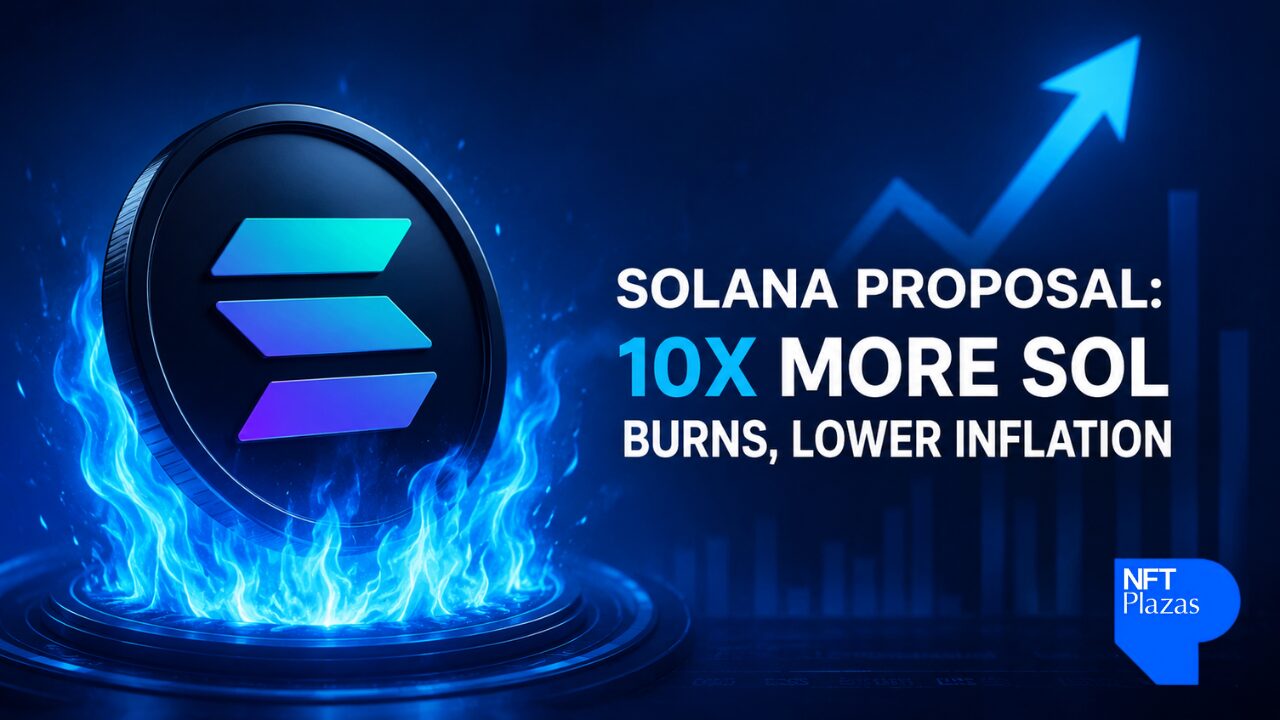
Solana validators are moving closer to advancing a governance proposal that could significantly reshape the network’s tokenomics by dramatically increasing the amount of SOL permanently removed from circulation while accelerating the reduction of new token issuance.
The proposal, SGP-0003, combines two previously introduced Solana Improvement Documents (SIMDs) into a single governance package designed to tighten SOL’s supply. If approved, it would increase daily token burns by more than tenfold while speeding up Solana’s path toward lower inflation, potentially strengthening the long-term supply dynamics of the blockchain’s native asset.
The proposal is currently in its signaling phase and has already attracted support from several prominent validators and infrastructure providers, with backing steadily approaching the threshold required to move to a formal vote.

Solana Proposal Would Increase Daily SOL Burns More Than 10-Fold (Source: X)
Two proposals designed to slow supply growth
SGP-0003 merges SIMD-0553 and SIMD-0550, each targeting a different side of SOL’s supply equation.
SIMD-0553 introduces a resource-based transaction fee model, replacing Solana’s relatively uniform fee structure with one that charges users according to the network resources consumed by their transactions. More computationally intensive transactions would therefore pay higher fees than simpler ones.
Because part of Solana’s transaction fees is burned, the proposal would dramatically increase the amount of SOL permanently removed from circulation. Estimates suggest daily burns would rise from roughly 650 SOL to between 7,500 and 9,000 SOL, increasing the value of burned tokens from about $48,000 to as much as $668,000 per day, depending on network activity.
The companion proposal, SIMD-0550, focuses on reducing new token issuance. It would double Solana’s annual disinflation rate from 15% to 30%, allowing the network to reach its long-term inflation floor of 1.5% by 2029 instead of 2032.
Developers estimate the faster disinflation schedule would reduce future SOL emissions by approximately 18.9 million tokens over the next six years, equivalent to around $1.36 billion at current market prices.
Working together, the proposals aim to slow the growth of SOL’s circulating supply by burning more existing tokens while issuing fewer new ones.

Higher burn rates alone would not be enough to counter Solana’s daily token emissions
Higher burns alone won’t make SOL deflationary
Despite the dramatic increase in token burns, SOL would not immediately become deflationary.
The Solana network currently issues around 60,000 SOL every day through its inflation schedule. Even if daily burns reach the projected maximum of 9,000 SOL, newly issued tokens would still outnumber those permanently removed from circulation.
That is why the two proposals have been packaged together. While SIMD-0553 increases token destruction through transaction fees, SIMD-0550 simultaneously reduces the pace of new issuance, narrowing the gap between supply entering and leaving the market.
Solana’s inflation rate currently stands at roughly 3.8%, having gradually declined from its original 8% launch rate under the network’s existing disinflation model.
Validator backing continues to grow
Before reaching a network-wide vote, the proposal must first clear Solana’s validator signaling process.
Under governance rules introduced by the Solana Foundation, proposals must secure support representing 15% of the network’s staked SOL before advancing to the discussion stage and eventually a formal validator vote.
Support has increased steadily this week.
According to the Solana Validator Governance dashboard, SGP-0003 has accumulated backing from approximately 63 million SOL, representing just over 14.4% of the network’s staked supply. That leaves roughly 3 million additional SOL needed to reach the required threshold of 65.16 million SOL before the August 18 deadline.
The proposal has received support from 73 validators, including major ecosystem participants such as Helius, Jupiter, Staking Facilities, Drift, OtterSec, and Solana Compass.
Earlier in the signaling process, Helius contributed the largest share of pledged support. The company has attracted additional attention because the engineer responsible for drafting SIMD-0550 is part of its team.
If the proposal reaches the required support threshold, it will proceed to the discussion phase before facing a formal validator vote.
Could tighter tokenomics benefit SOL?
If approved, SGP-0003 would represent one of the most significant updates to Solana’s monetary policy since the network launched.
Supporters argue that reducing long-term token issuance while increasing transaction-fee burns could strengthen SOL’s scarcity over time. Although the proposal does not guarantee higher prices, slower supply growth could improve the token’s long-term fundamentals if network adoption and investor demand continue to expand.
Still, SOL’s price will remain influenced by broader market conditions, institutional participation, on-chain activity, and overall sentiment across the cryptocurrency sector.
SOL is currently trading around $74, giving the network a market capitalization of roughly $43 billion. While the token has posted modest gains recently, it remains well below its all-time high of approximately $293 reached during the previous market cycle.
Market sentiment also remains cautious. Traders on Myriad, the prediction market developed by Decrypt’s parent company Dastan, currently assign roughly 70% odds that SOL falls to $40 before eventually recovering to $160, reflecting continued uncertainty despite the proposed supply reforms.
With less than two weeks remaining before the August 18 signaling deadline, validator support will determine whether SGP-0003 advances to the next stage of Solana’s governance process. If ultimately approved, the proposal would tighten SOL’s supply from both ends—burning substantially more tokens while issuing fewer new ones—marking one of the network’s most consequential tokenomic changes to date.






Leave feedback about this