
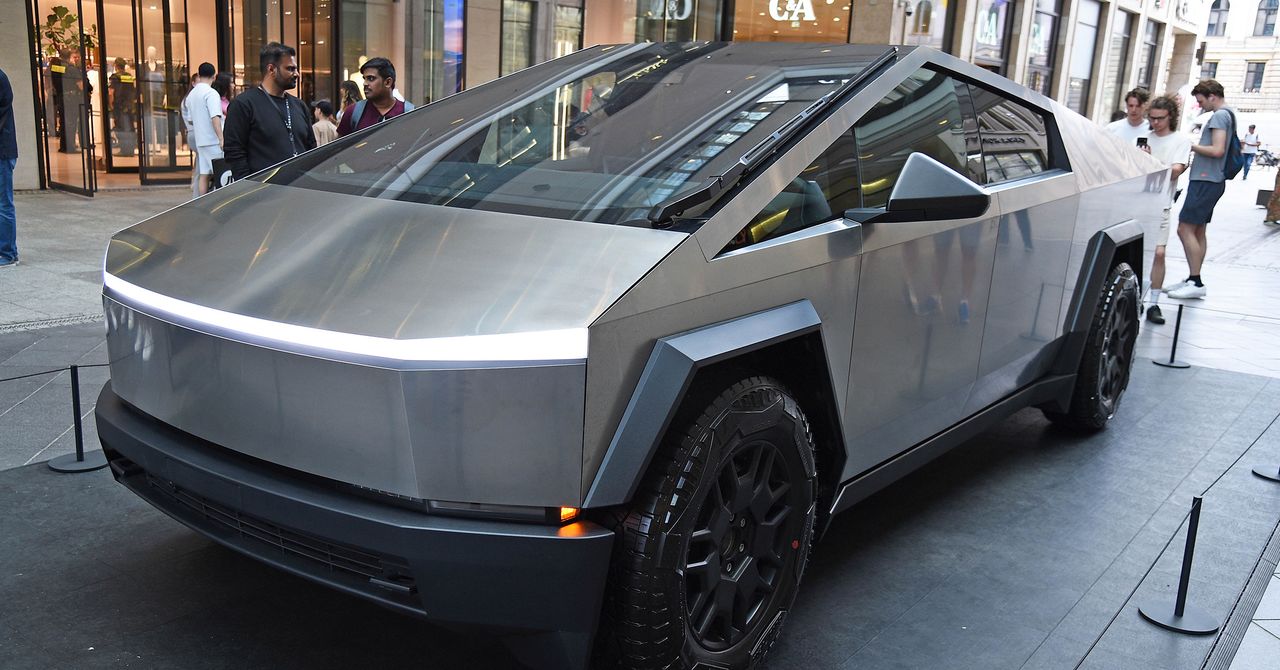
Tesla will end production of the Cybertruck at its Texas Gigafactory next year.
It’s a uniquely toxic electric vehicle, between its divisive design and Elon Musk’s embrace of you name it. That toxicity certainly contributed to subpar sales, along with a number of recalls.
But the end of the Cybertruck is also another sign that the era of big EVs—particularly big trucks—is waning. That’s great news for pedestrian and biker safety, but also for the battery supply chain at a time when more people need to get behind the electric wheel.
The Cybertruck uses a massive 123 kilowatt-hour battery that clocks in at around 1,600 pounds, or around a quarter of its weight. That’s on par with the battery that powered Ford’s F-150 Lightning, another electric truck that was canceled late last year. (The company also killed a three-row EV in 2024.) Ford’s behemoth batteries ranged from 98 kilowatt-hours up to 131 kilowatt-hours.
Seeing both trucks canceled within a year of each other, while automakers have announced a bevy of smaller EVs and gas-powered autos with electric motors that can extend range, indicates there may be a shift afoot. Ford is planning to launch the Fathom next year. The sub-$30,000 electric pickup is expected to be about the size of the automaker’s compact gas-powered Maverick pickup. Though Ford hasn’t announced the battery sizes available in various trims, it’s a safe bet they won’t be anywhere near the size of the F-150 Lightning or Cybertruck. The company is also planning to relaunch the Lightning as an extended-range model.
Startup Slate is also launching a tiny electric pickup that can be converted to an SUV, with a bare-bones base model starting below $25,000. It also features a svelte battery and has seen a massive surge in preorders—though, to be fair, so did the Cybertruck, and we saw that turned out.
Then there’s the Rivian R2, which launched this year. While the SUV isn’t as tiny or cheap as Ford and Slate’s vehicles—its battery has 88 kilowatt-hours of capacity and weighs in at around 1,200 pounds—it’s still smaller than the company’s flagship R1S. Rivian has also teased the R3, an even more-slimmed down SUV, in the coming years.
That’s not to say big EVs are dead. The Kia EV9, for example, is among the top 10 EVs by sales in the US, as is the R1S. There’s also a torrid resale market for the F-150 Lightning. But the rest of the top 10 new EV sales are all crossovers, sedans, or mid-sized SUVs with moderately sized batteries, and a number of newly announced EVs are trending on the smaller side or function as extended range vehicles.







Leave feedback about this